
Modern pinball machines have very little to do with their ancestors from the 80s. HD displays, RGB lighting and advanced micro-mechanics are the new building blocks of these high-tech toys. As much as it hurts, 1986 was 40 years ago and both technology and expectations have changed radically.
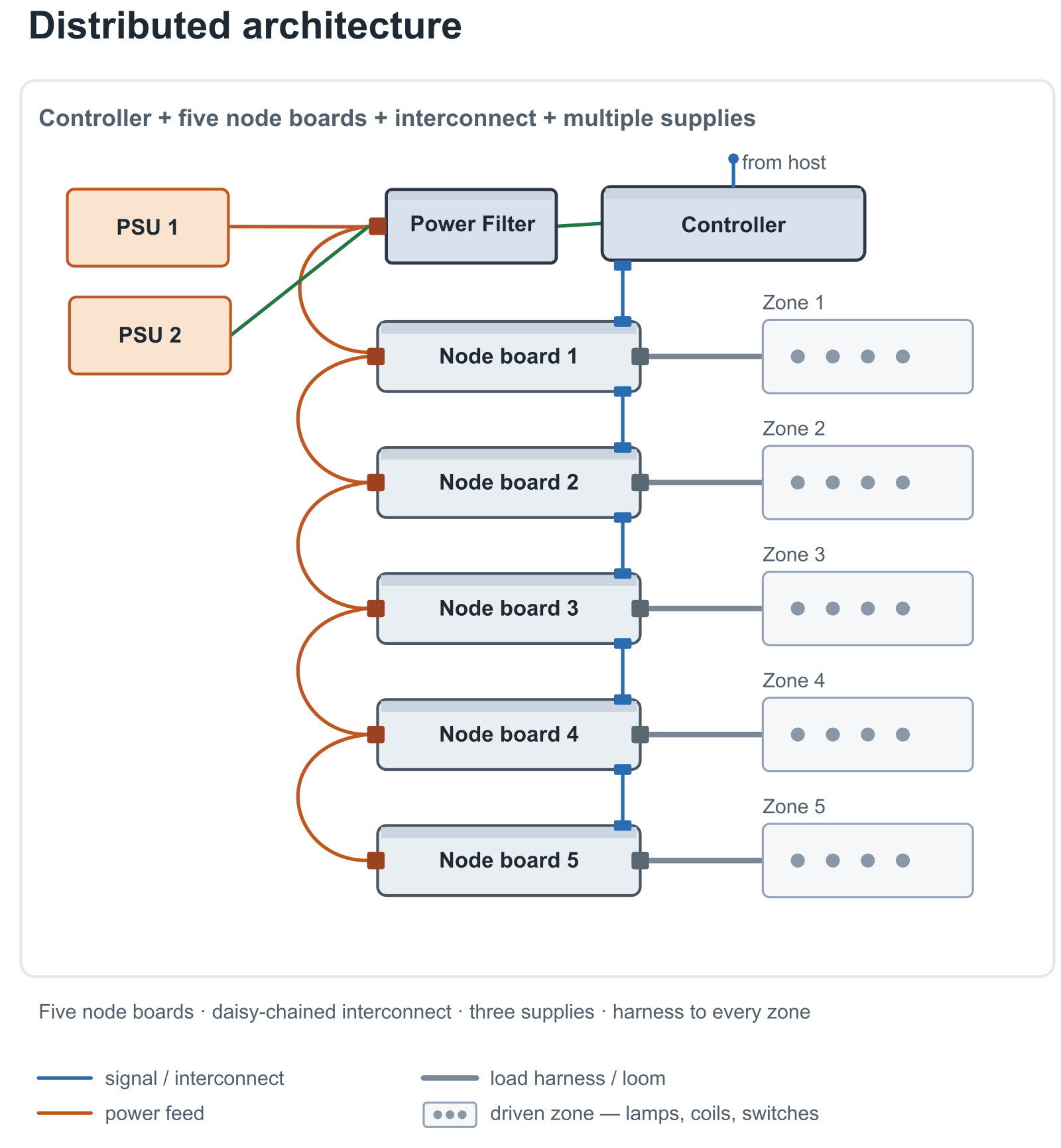
This added complexity in gameplay and toys has a knock-on impact on the engine of the game — what is hidden from the player’s perspective. This engine is called a controller: it’s what makes the machine work. A recent trend is to use distributed small controllers (sometimes called Nodes), and for good reasons. Node boards scattered around the machine keep the wiring local, let a builder add exactly the I/O a given machine needs, and make the system expandable — bolt on another node when the playfield grows a new toy.
The costs are less advertised.
A distributed system means a communication bus and a very carefully managed ground reference with high-current solenoid returns sharing that structure. Ground management stops being a layout detail and becomes the thing that determines whether the machine works. It means a microcontroller on every node — each one a point of failure, each one with its own firmware. Which in turn means reflashing node boards: a maintenance operation that has to succeed on every board, in the field, or the machine doesn’t boot.
So the Nexus Pinball Controller asks a different question. What happens if you put everything back on one board and use the headroom that current technology gives you?
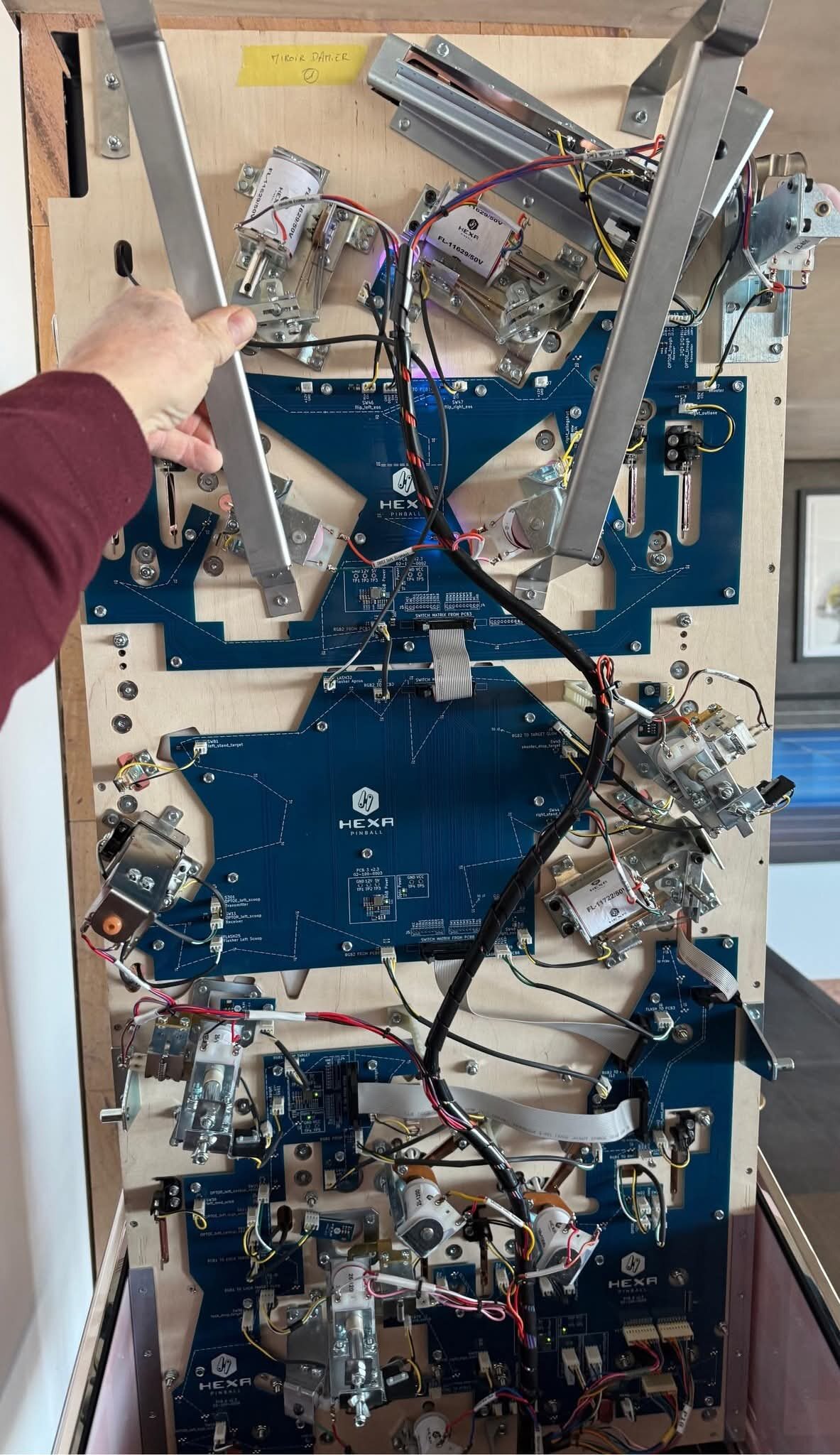
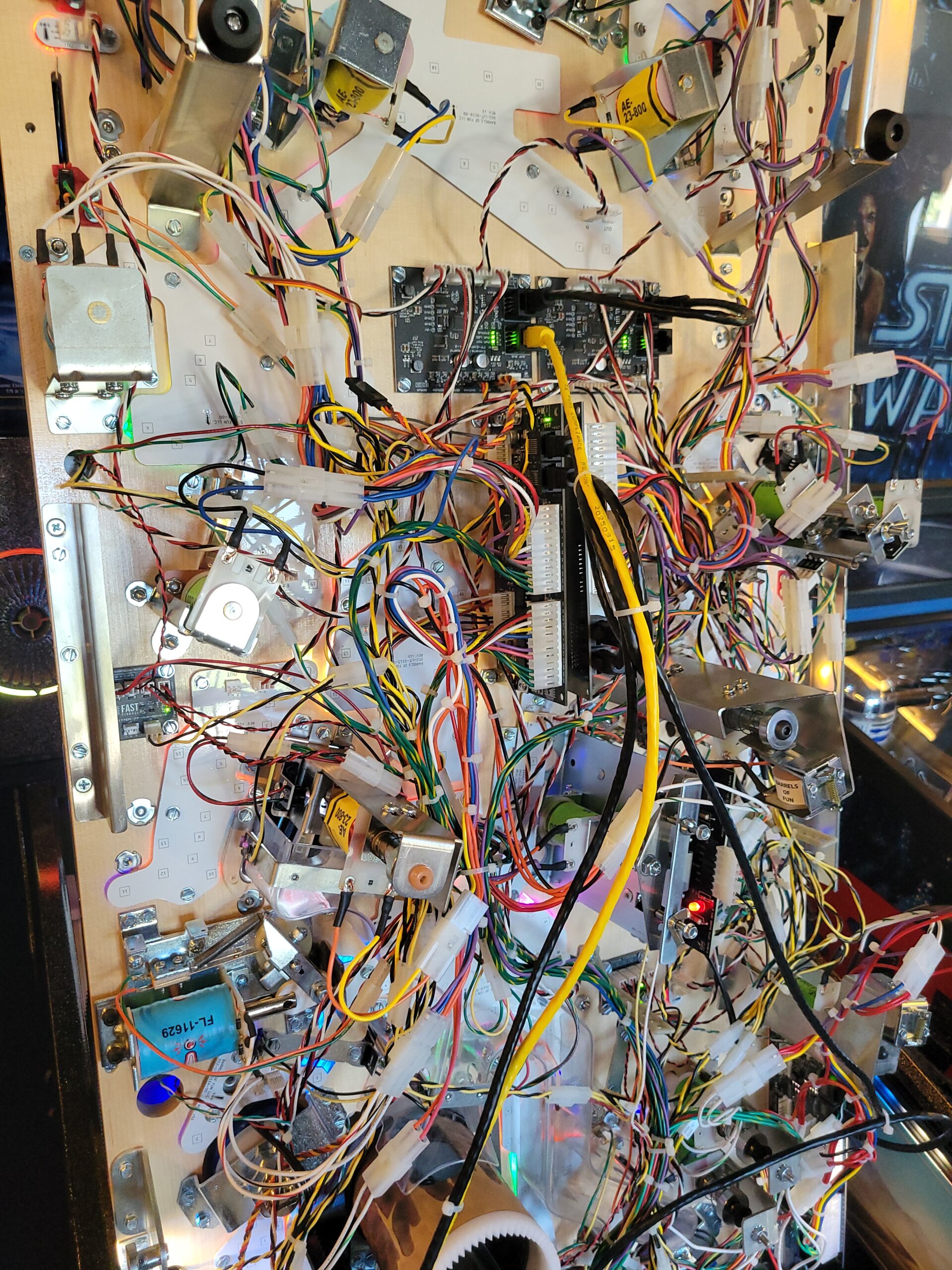 Competitors
Nexus Pinball Controller
One board
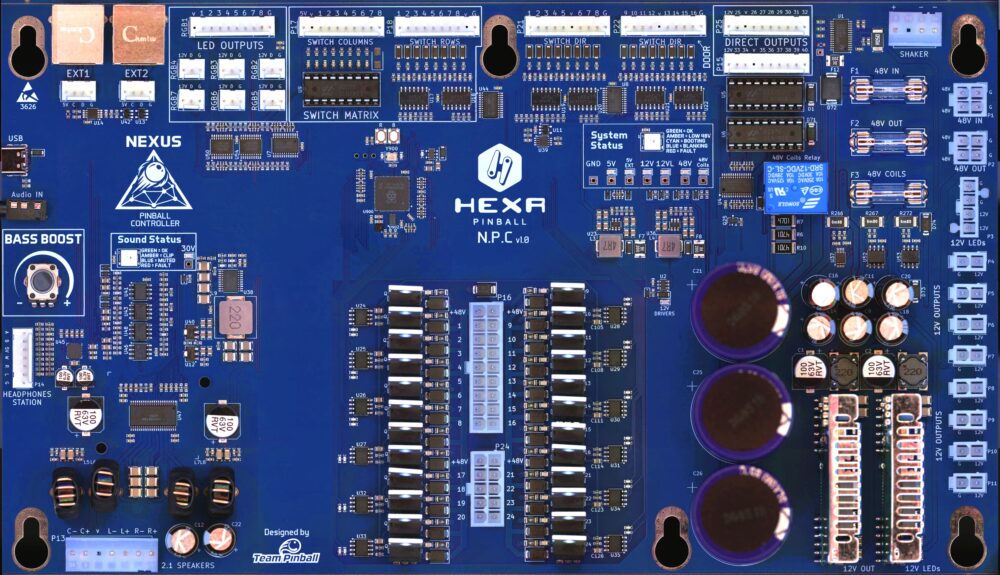
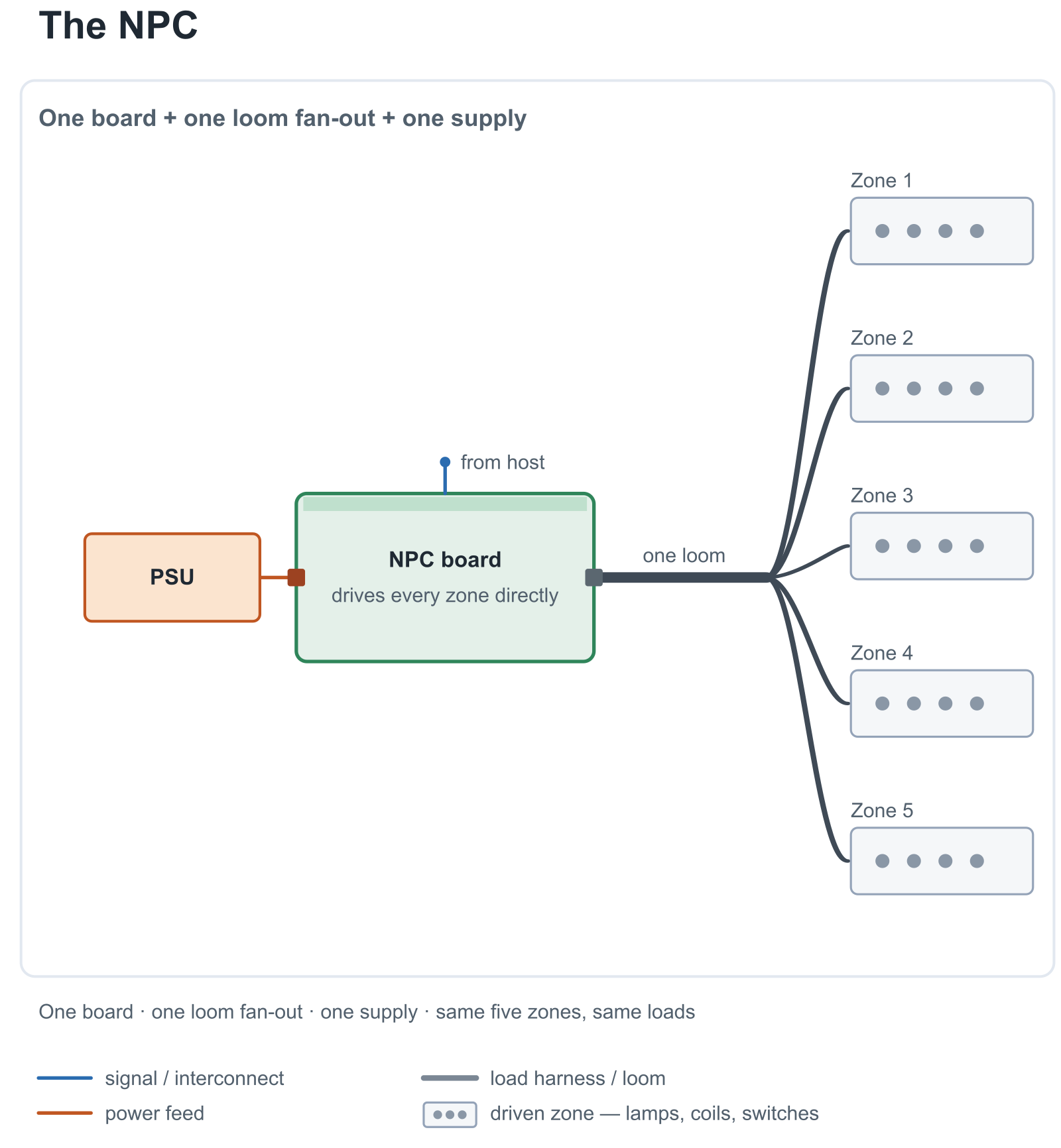
Everything lives on a single All-in-One PCB: the processor, the coil drivers, the switch inputs, the LED drive, the power distribution and the audio amplifier.
One board means one ground. Every return, every reference, every high-current path resolves on a single copper structure that was designed as a whole rather than assembled from cable. The most difficult problem in a distributed pinball system doesn't get solved — it stops existing.
It also means one thing to flash. One firmware image, one version, one update. No node inventory, no per-board version matrix, no partial upgrade leaving a machine in a bricked state waiting for a board replacement.
And it means one point of failure instead of a dozen — which sounds worse until you count. A single board that works is more reliable than eight boards that each work, plus the connectors and cable between them.
One board, and one job. The processor is Raspberry Pi’s RP2350, two cores at 150 MHz — and it is deliberately not the machine’s computer. That is a mini-PC running MPF, the open-source Mission Pinball Framework, driving the displays over HDMI and connected to the NPC over USB. MPF decides what the game does; the NPC decides what the hardware does, and holds the rules that have to be obeyed either way: this switch fires that coil, at this power, for this long, and never longer. The host installs them once and is then out of the path.
Standard supplies, one input
The NPC runs from a single 48 VDC, 500 W power supply. That's it — the kind of unit you can buy anywhere, replace anywhere, and stock a spare of without a lead time.
The board filters it and generates the lower voltages itself, with no need for a separate filter board, using two off-the-shelf 12 V, 100 W converters. Again, that's one less board to worry about.
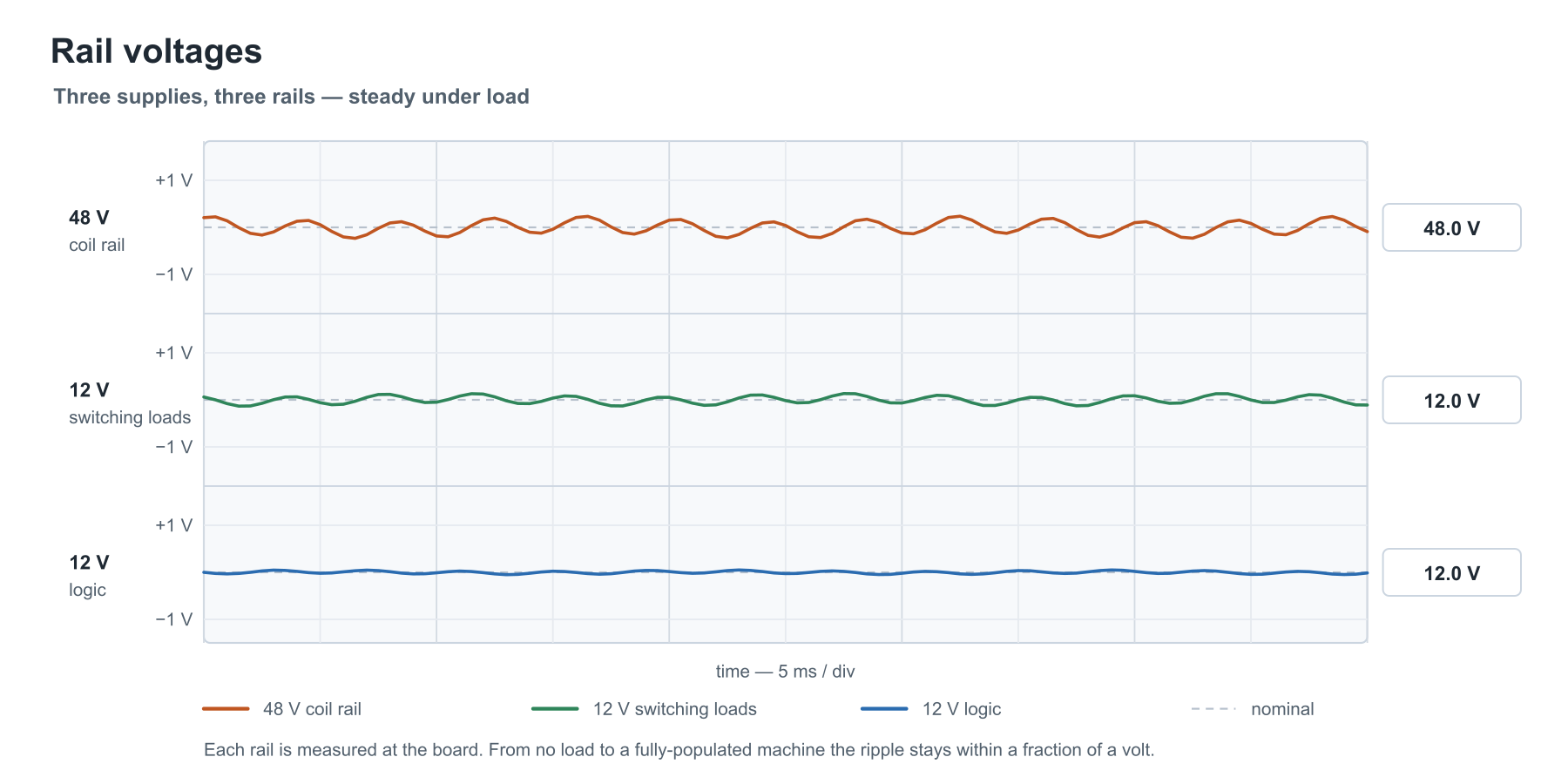
There is no exotic rail, no bespoke supply, no chain of connectors distributing three or four voltages around a cabinet. Which also means no ground-loop issues — the kind that stay invisible until the machine is fully assembled and the audio starts humming.
Two 12 V supplies rather than one is deliberate: it separates the heavy switching loads from the computer and displays. 200 W is comfortable headroom for a fully-populated machine.
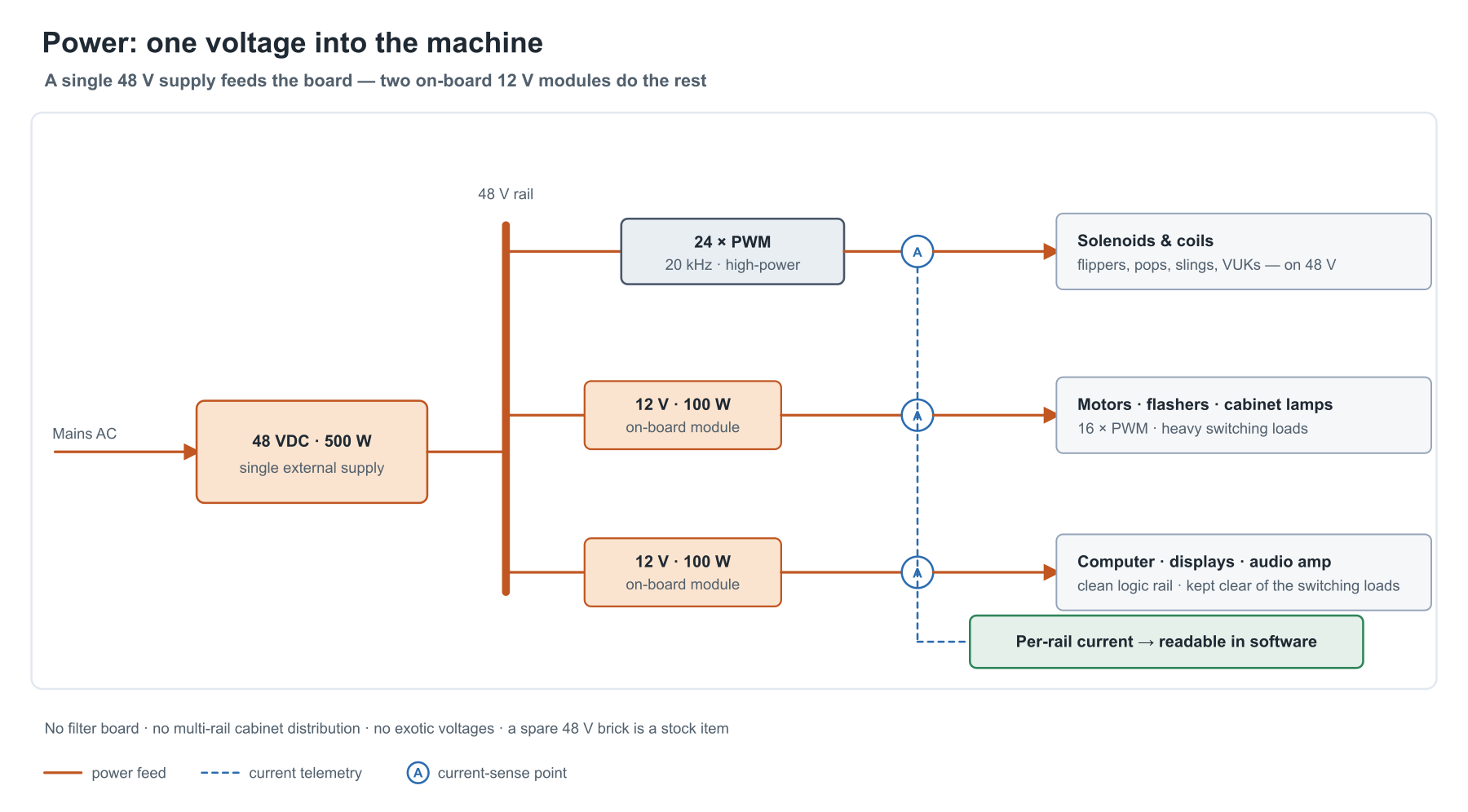
Current on every rail is measured in hardware, and readable from software. A coil pulling more than it should becomes a diagnostic message instead of a mystery.
Every coil is PWM. Every single one.
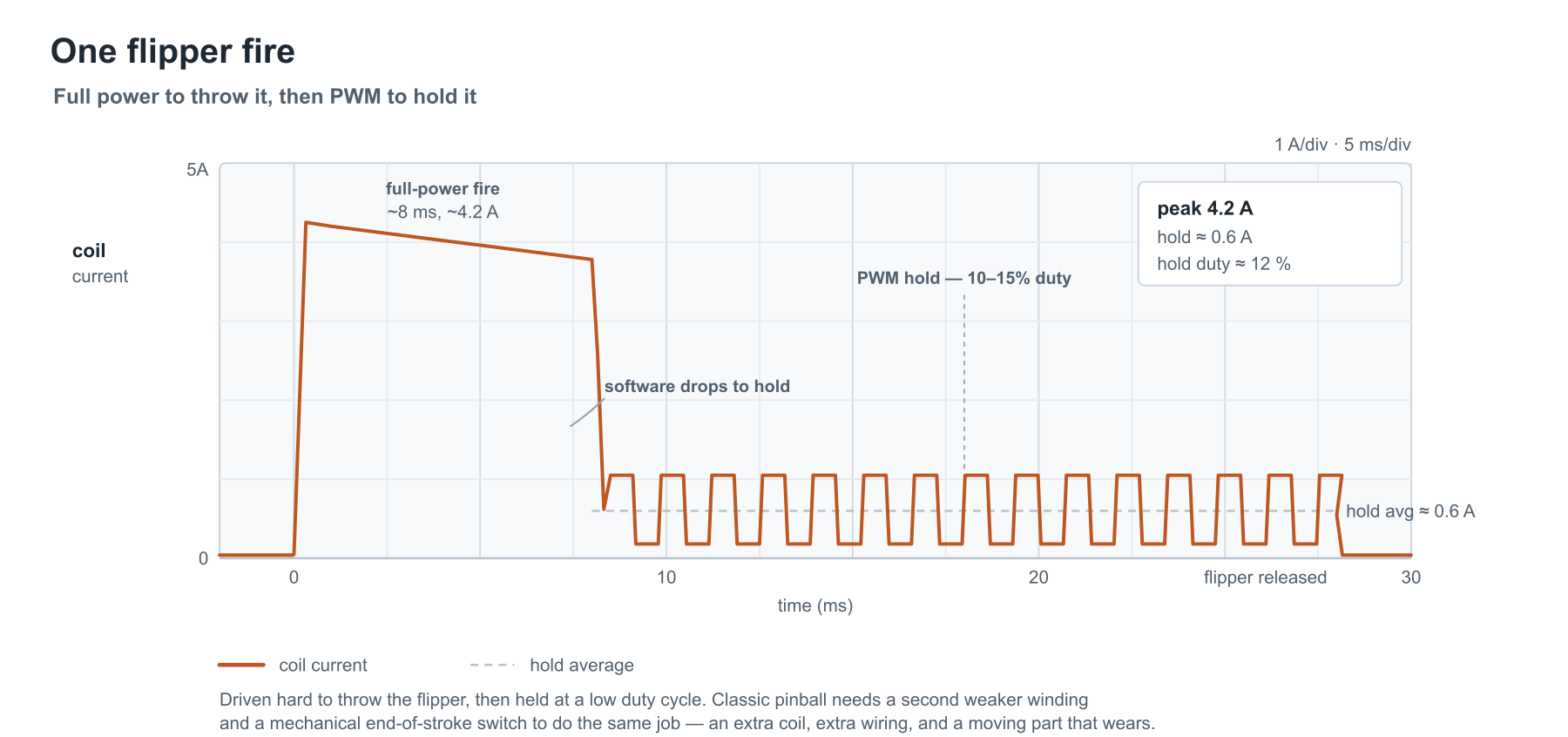
Classic pinball drives a coil by switching it hard on and trusting the software to switch it off before the winding cooks. Flipper hold comes from a second, weaker winding selected by a mechanical end-of-stroke switch — an extra coil, extra wiring, and a moving part that wears.
The NPC drives every output under pulse-width modulation:
- 24 high-power PWM outputs switching at 20 kHz — above audibility, so no coil whine
- 16 PWM outputs for motors, flashers and cabinet lamps
- Extension connectors for more if necessary
The freewheel diodes are on the board. Every output has its own ultra-fast diode clamp, sized for the switching speed, already fitted and already tested. This is worth stating plainly because of what it removes from the build: you no longer solder a diode across every solenoid. No diode across the flipper coils, none on the pops, none on the slings — and no chance of fitting one backwards, a fault we have all faced far too often.
What PWM changes in practice:
Hold becomes software. Fire a flipper at full power, drop to a 10–15 % duty cycle to hold it. Single-winding coils, no end-of-stroke switch, one less mechanical failure point per flipper, one less wire.
Strength becomes a number. Flipper power is a config value. Tune it for a fast playfield or a slow one without touching hardware. A weak pop bumper is a settings change, not a coil swap.
New effects become possible. Ramp a coil instead of firing it. Soft-launch a ball. Drive a shaker motor along a real intensity curve rather than on and off.
Coils stop burning out. The most common cause of a dead coil in a homebrew machine is software leaving it energised. Current-limited PWM plus hardware watchdogs makes that failure far less punishing.
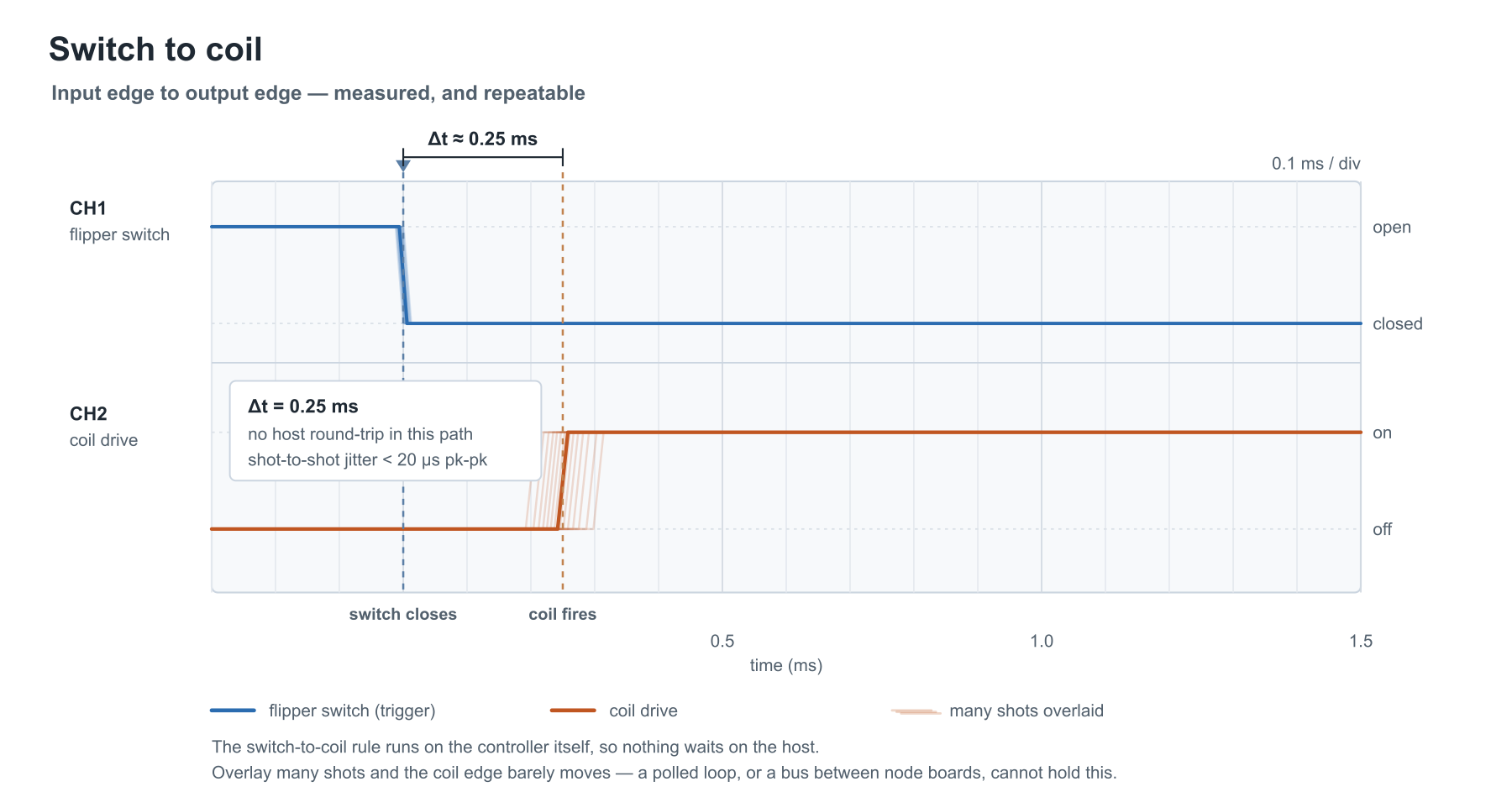
And the reaction time comes from the same place. Because the switch-to-coil rule lives on the NPC itself, a flipper never waits on a round trip to the host — and no amount of clever code at the far end would fix it if it did. With the rule already on the board, the only thing between the switch edge and the coil edge is the hardware itself: about 0.25 ms, shot after shot, with under 20 µs of shot-to-shot jitter — far below anything a player can feel.
RGB lighting driven properly
Every insert, every ramp and every cabinet accent is an individually addressable RGB LED — no lamp matrix, no fixed colour decided by the bulb behind the plastic. The data that drives them is produced by the RP2350’s programmable I/O — state machines that generate the waveform in hardware, on their own clock — rather than bit-banged from a processor core.
Sixteen chains, not one. The addressable-LED protocol clocks at 800 kHz, and every LED on a chain swallows 24 bits of that — 30 µs each, every frame. Hang 500 LEDs off a single data line and one frame takes 15 ms, which caps the whole playfield at roughly 60 Hz before the machine has been asked to do anything else. The NPC drives 16 chains in parallel: the same 500 LEDs sit about 30 to a chain, and a full-playfield frame clocks out in under a millisecond. Aggregate LED bandwidth is 12.8 Mbit/s.
That headroom is what the attract mode below is spending. Thirty frames a second across 500-odd LEDs isn’t a budget to manage, it’s the easy case — and because the timing comes out of hardware, the frame rate doesn’t collapse when the game gets busy. No flicker with three balls in play and eight coils firing.
The LEDs run at 12 V, on the same rail as everything else. For the same brightness a 12 V string draws less than half the current of the 5 V equivalent, and that one change pays three times over: far less voltage drop along a run, so no colour shift at the far end of a chain; thinner wire and no power injection half-way down the playfield; and no separate 5 V distribution to build, route and fuse. The lighting simply takes the voltage the rest of the machine already runs on.
And a failed LED doesn’t take the rest of the chain with it. Each device carries a backup data line alongside the main one: if one fails, the signal routes around it and everything downstream keeps running. On a conventional string a single dead LED blacks out every insert after it, and finding the culprit means working along the run. Put that together with 16 short chains instead of one long one and the worst case stops being half a dark playfield — it becomes one dark insert.
Sound, on the same board
Audio isn’t an add-on either. The NPC carries a 200 W 2.1 amplifier on board — stereo plus a dedicated subwoofer channel — with its own status indicator and a bass-boost control on the board itself. A machine gets cabinet-shaking sound without a separate sound board, without a supply to feed it and without another loom running back to the controller.
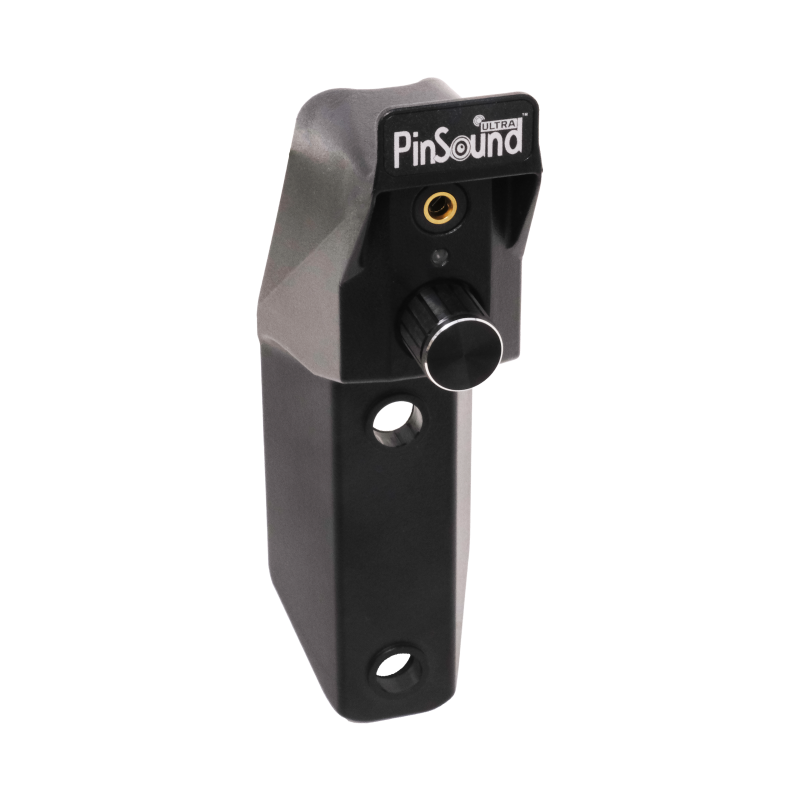
The audio section is also HPSU compatible: a PinSound Headphone Station plugs straight into the board, with its own volume at the front of the cabinet. Full-volume play when the room allows it, headphones when it doesn’t — and no adapter board in between.
Built from parts you can still buy in ten years
Every component on the board is current, in volume production and orderable from ordinary distributors today. The Mosfets are industry standard IRF540, ICs from reputable brands such as TI and Meanwell Power Supplies. Nothing is a grey-market pull, nothing is end-of-life.
For a platform meant to keep a machine running for decades, that matters as much as any feature above.
A step forward in pinball design
The NPC is what a pinball controller looks like when it is designed for the parts that exist now. It is the most capable controller on the market, and it is also the simplest thing in the machine. Those two things are not in tension: the capability is what removes the complexity. Every feature above takes something out of the cabinet instead of adding to it.
That is what matters beyond this one board. A machine built on the NPC is not already at the limit of what it can do. It has room for what designers will want over the next five to ten years — with a loom one person can build in an afternoon, from parts anyone can still order.
Working on a machine, or on any system where the control architecture has outlived the constraints that shaped it? Get in touch.